
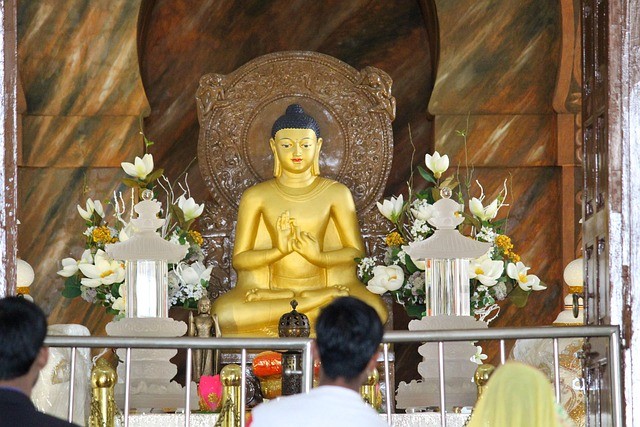
Jainism is an ancient Indian religion that emphasizes non-violence, self-discipline, and the pursuit of enlightenment. It is founded on the principle of respecting all living beings and strives for liberation from the cycle of re-birth through right knowledge, faith, and conduct.
The theory of Karma in Jainism is that nothing happens without a cause. Each individual is responsible for his or her own actions. These actions are the cause that produce proper effects in time. This is the law of Karma. A person should make good use of the knowledge of the law, that good actions generate good fruits and bad actions generate bad fruits. Then he will hesitate to perform bad actions and feel elated to perform only good ones. At times, under certain circumstances, we are constrained to disregard the law of Karma and forced to perform evil actions against our will.
What is Karmic matter? The literal meaning of the Sanskrit word ‘Karma’ is ‘deeds’, including thoughts and words. Karmas are invisible, fine particles of matter prevailing all around us just like air particles. Jainism believes that karmic particles are a physical substance which are everywhere in the universe. Bondage occurs when karmic particles are attracted to our soul on account of the activities of the mind, speech and body. Bad karma collects and clings to the soul leading to misery, inequalities in mental and physical attainments etc. Each soul is possessed of ‘consciousness’ which has the power to perceive and gain knowledge. It is the doer of all actions. This consciousness has the inherent tendency to move upwards, however, Karmic matter draws a veil over the natural qualities of the soul, crippling its powers. Jainism believes that it is the primary function of religion to stem the inflow of bad Karma, to lessen the presence of Karma already attached to the soul and to show the path of liberation through which the soul could achieve perfections.
Tirthankaras: Twenty-four spiritual teachers, with Mahavira being the last and most prominent, are considered to have achieved enlightenment and paved the way for others to follow. These twenty four teachers are called Tirthankaras. The word tirthankara signifies the founder of a tirtha, a fordable passage, across the sea of perpetual birth and death in the world.

Leave a Reply